A step-by-step guide for food companies on how to conduct a sustainability gap analysis, identify ESG compliance gaps across sourcing, packaging, and reporting, and build a practical action plan to close them.

Maikel Fontein
9
min

If your team is fielding more ESG requests than it was two years ago, you are not imagining it. CSRD, EUDR, and a growing list of customer-driven sustainability requirements mean that food companies are under more scrutiny than ever, from regulators, retailers, and investors alike.
A sustainability gap analysis is how you get ahead of that pressure instead of constantly reacting to it. It is a structured process for evaluating where your current ESG practices stand against what regulations and customers actually require, identifying what is missing, and building a plan to close those gaps systematically.
This guide walks through how to conduct one practically, with practical tips and food-industry examples so you can see how this approach comes to life in real situations.
What is a Sustainability Gap Analysis, and Why Does It Matter For Food Companies?
A sustainability gap analysis is a structured process for evaluating where your current ESG practices stand against what regulations, customers, and industry standards actually require, and identifying what needs to change to close that distance.
For food companies specifically, the stakes are high. Regulations like CSRD, EUDR, and the EU Green Deal set specific targets around emissions reporting, deforestation-free sourcing, and packaging waste. Falling short of these requirements can result in penalties, loss of retailer relationships, and reputational damage that is difficult to recover from.
Beyond compliance, a gap analysis often surfaces operational inefficiencies that have a direct cost impact. Gaps in energy consumption, waste management, or sustainable sourcing practices are not just regulatory risks, they are also areas where improvement translates directly into cost savings and stronger supplier and customer relationships.
How to Identify Gaps in Compliance with Sustainability Regulations
Identifying where your gaps actually are requires looking at your current practices through the lens of what specific regulations demand, not just what you think you are doing well.
Define which regulations apply to your business: For food companies, the most relevant frameworks right now are EUDR, which requires deforestation-free sourcing for commodities like soy, palm oil, and cocoa; CSRD, which sets comprehensive sustainability reporting obligations; the EU Farm to Fork Strategy, which covers environmental targets across food production and consumption; and EU packaging regulations, which set recyclability and waste reduction targets. The starting point is knowing which of these apply to your specific operations and supply chain.
Audit your current practices against those requirements: Once you know what is required, conduct an honest internal audit of where you stand. For a food company this typically means reviewing sustainable sourcing practices across your supply chain, waste management and packaging processes, water usage and energy consumption data, and ESG reporting completeness. If you have gaps in data availability or reporting, that in itself is a finding worth noting.
Compare and identify discrepancies: Put your audit findings next to the regulatory requirements and look for the distance between them. For example, a food company producing packaged goods might discover through their audit that only 40% of their packaging is recyclable, a hypothetical but realistic finding that creates a clear and measurable gap against EU packaging targets. The more specific you can be about the gap, the easier it is to build a plan to close it.
Engage the right internal stakeholders: A gap analysis cannot be done by one department in isolation. Supply chain teams will have visibility on sourcing compliance issues. Operations teams hold energy and waste data. Legal and compliance teams understand the regulatory obligations. Getting input from all of them early prevents gaps being missed and builds the cross-functional alignment you will need to act on the findings.
Best Practices For Conducting A Sustainability Gap Analysis In The Food Industry
Organise and centralise your knowledge base
Gather your existing policies, certifications, and ESG data into one accessible location before you start. The easier it is to find what you already have, the faster you can identify what is missing.
Use AI tools to navigate complex frameworks
AI tools can help summarize large framework documents and surface relevant requirements quickly. They can miss framework-specific nuances though, so for deeper work on specific schemes like EcoVadis it is worth working with specialists. Consultants like 2Impact bring both the technical knowledge and practical experience of where food companies typically fall short.
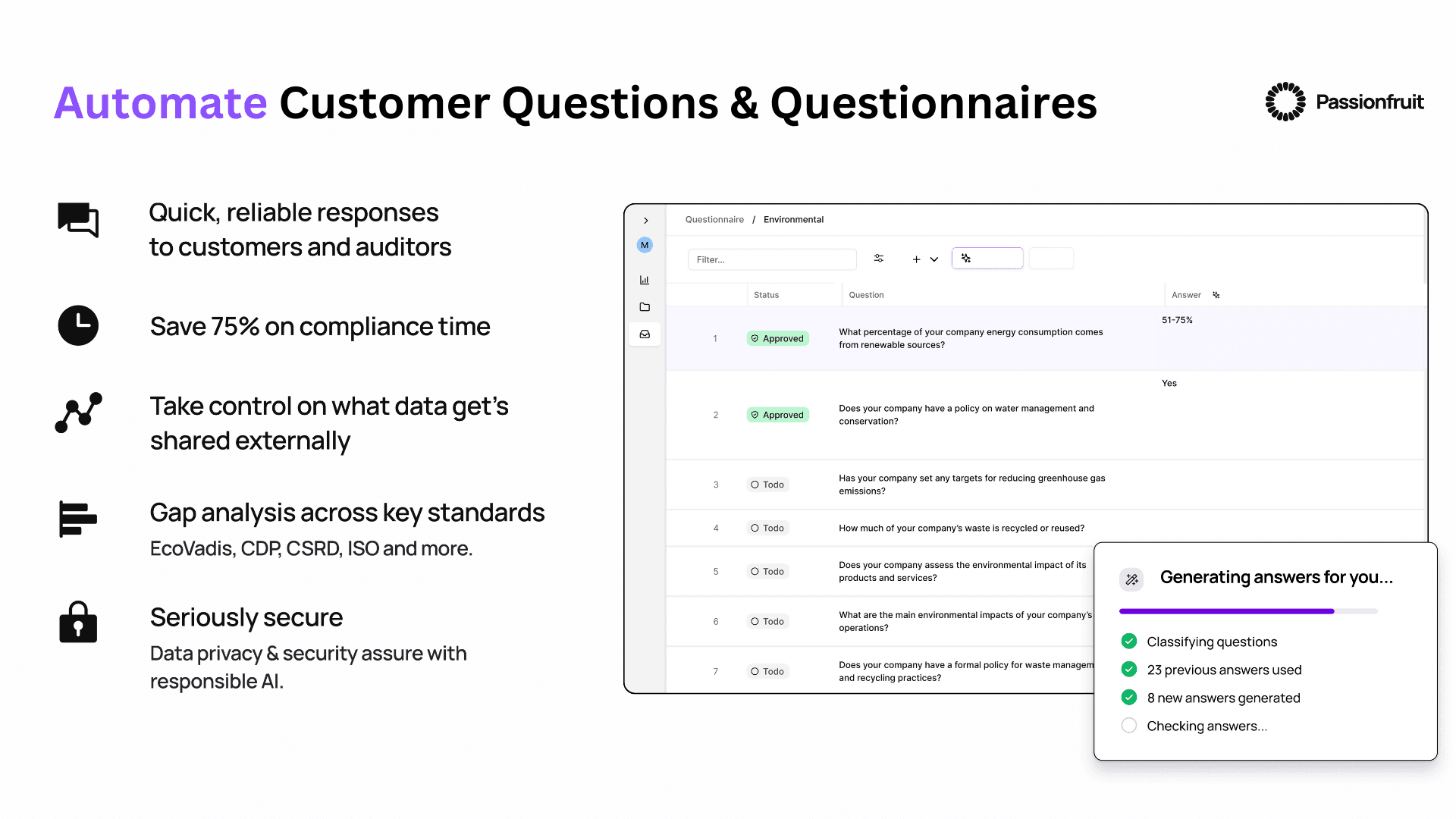
Use automation to speed up the analysis
Manually scanning internal documents to identify compliance gaps is slow and inconsistent. Tools like Passionfruit can scan your existing documents, identify gaps against specific framework requirements, and surface actionable insights in a fraction of the time..
Focus on High-Impact Areas
A successful sustainability gap analysis isn’t just about ticking boxes—it’s about prioritizing the areas that will have the most significant impact. In the food industry, this often means focusing on sustainable sourcing, waste management, and energy efficiency.
Sustainable sourcing: For companies using commodities like palm oil, it’s critical to ensure that your suppliers are certified by recognized programs like Rainforest Alliance or Fair Trade. This will ensure your practices meet sustainability goals while protecting your brand from reputational risks.
Waste management: Food companies must address waste, both in production and packaging. Conducting a waste audit can reveal opportunities to reduce food waste, improve inventory management, or find more sustainable packaging options.
How To Turn Your Gap Analysis Findings Into An Action Plan
Identifying gaps is only useful if it leads to action. Here is how to turn your findings into a concrete plan.
Set clear, measurable goals: Start by defining tangible goals. For instance, a food company might aim to reduce carbon emissions by 20% in the next five years or increase the use of sustainably sourced ingredients to 75% by the end of next year. These goals should reflect both regulatory requirements and your internal sustainability targets.
Develop an action plan: Based on the gaps identified, create a detailed action plan with timelines, responsibilities, and resources. For example, if packaging materials don’t meet recyclability standards, your plan might include transitioning to more sustainable packaging options and implementing a company-wide recycling program.
Monitor progress regularly: Tools like Passionfruit can help you track progress against your sustainability goals in real time, flagging where you are falling behind and making it easier to course correct before gaps widen.
Engage stakeholders: Throughout the process, it’s vital to engage all relevant stakeholders. From internal teams to suppliers, everyone must be aligned and working toward the same sustainability goals. Regular meetings, training sessions, and workshops can ensure everyone understands their role in achieving sustainability objectives.
A Sustainability Gap Analysis In Practice: Food Packaging And EU Compliance
Let’s consider a hypothetical food company that produces packaged snacks and wants to conduct a sustainability gap analysis to comply with new EU regulations on packaging waste.
Define the Regulations: The company would first review the EU package and packaging waste initiative, which mandates that companies meet specific targets for reducing packaging waste and increasing recyclability.
Evaluate Current Practices: The company conducts an internal audit of its packaging materials and waste management processes. It discovers that while 40% of its packaging is recyclable, the other 60% is not.
Compare Practices with Regulations: The gap analysis reveals that the company is not meeting the recyclability requirements set by the EU regulation and will need to increase the percentage of recyclable packaging to at least 75%.
Engage Stakeholders: The company collaborates with its suppliers to source recyclable materials and with its packaging team to redesign product packaging.
The action plan could then include setting goals to reach 75% recyclable packaging within two years, identifying key suppliers who provide sustainable packaging solutions, and implementing a company-wide recycling program to meet EU compliance.
Conclusion
Conducting a sustainability gap analysis is essential for food companies to assess where they stand against sustainability regulations and build a concrete plan to close the distance. By identifying gaps in sourcing, packaging, and reporting, setting measurable goals, and engaging the right stakeholders, companies can move from reactive compliance to a position of genuine operational confidence.
Related articles: